Mindrill Equipment Guide
DTH vs Top Hammer Drilling: Which Method Works Best for Different Rock Types?
A practical, no-nonsense comparison to help you choose the right drilling method for your application — from the experts at mindrill.com
If you've spent any time in the drilling industry, you already know that choosing the right method can be the difference between a smooth, productive operation and an expensive, time-consuming headache. Two of the most widely used drilling methods in mining, construction, and water well applications are DTH (Down-The-Hole) Hammer drilling and Top Hammer drilling. Both are proven technologies with distinct strengths, and both have situations where they clearly outperform the other.
The question isn't which one is better in general — it's which one is better for your specific application, your rock formation, and your project requirements. At Mindrill, we supply both DTH Hammer and Top Hammer equipment, so we're not here to push one over the other. We're here to give you an honest, practical breakdown so you can make the right call on your next project.
What Is DTH Hammer Drilling?
In DTH Hammer drilling, the hammer mechanism travels down the borehole along with the drill bit. The hammer sits directly behind the drill bit at the bottom of the hole, meaning the percussion energy is delivered right at the rock face with minimal energy loss through the drill string. Compressed air powers the hammer and simultaneously flushes the drill cuttings back up to the surface.
Because the energy source is so close to the cutting face, DTH Hammer drilling maintains consistent penetration rates as depth increases — something that top hammer systems can struggle with on deeper holes. This makes the DTH Hammer particularly effective in applications that demand deep, straight, and accurate boreholes.
What Is Top Hammer Drilling?
With Top Hammer drilling, the percussion unit sits at the top of the drill string, above the ground surface. The impact energy is generated at the top and transmitted down through a series of drill rods to the bit at the bottom. This method relies on the drill string itself to carry the hammer energy to the rock face.
Top Hammer is a well-established and highly efficient method for shallower holes, and it excels in terms of drilling speed at shorter depths. It is widely used in quarrying, tunneling, surface mining, and construction blasting where hole depth requirements are typically moderate and high penetration rates are a priority.
Rock Types Where DTH Hammer Drilling Excels
The DTH Hammer is at its best when conditions are tough, deep, or abrasive. Here's where it consistently delivers superior results:
Hard and Abrasive Rock Formations
Granite, basalt, quartzite, and other hard, dense rock formations are where the DTH Hammer truly shines. The direct percussion at the bit face ensures maximum energy transfer into the rock, even when the formation is highly resistant. The result is a consistent penetration rate that doesn't deteriorate just because the rock is tough.
Deep Hole Applications
One of the most significant advantages of DTH Hammer drilling is that its performance does not degrade with depth the way top hammer systems can. Since the hammer is always right at the bottom of the hole, the energy delivered to the bit remains consistent whether you're at 20 meters or 200 meters. For water well drilling, geothermal projects, and deep blast hole drilling, the DTH Hammer is typically the method of choice.
Fractured and Variable Ground Conditions
When the ground alternates between soft and hard layers, or when fractures and voids are present, the DTH Hammer handles the transitions more smoothly. Its ability to maintain borehole straightness is a major advantage in fractured formations where top hammer rods can deviate unpredictably.
Best applications for DTH Hammer drilling:
- Water well and geothermal drilling
- Deep blast hole drilling in open-pit and surface mining
- Foundation and anchoring work in hard rock
- Oil and gas exploration drilling
- Infrastructure projects requiring deep, accurate boreholes
Rock Types Where Top Hammer Drilling Excels
Top Hammer is not the lesser option — it's simply designed for different conditions. In the right environment, it can outpace DTH Hammer significantly in terms of speed and cost efficiency.
Shallow Holes in Hard Rock
For shallow blast holes in quarries and surface mines, Top Hammer drilling is hard to beat. The high-frequency percussion delivered from the surface allows for extremely fast drilling in competent, hard rock when depths are limited — typically under 30 to 50 meters. The drilling speed of a well-maintained Top Hammer rig in the right conditions can be impressive, and the lower air consumption compared to DTH Hammer systems translates directly into lower operating costs per meter.
Underground Tunneling and Development
Top Hammer equipment dominates in underground tunneling and development drilling. The compact design of top hammer rigs makes them ideal for working in confined underground headings, and their ability to drill rapid, accurate patterns for blasting rounds is unmatched at those depths. Underground mining operations around the world rely on Top Hammer drills for face drilling, production drilling, and bolting applications.
Medium-Hard to Hard Competent Rock
In medium-hard to hard, relatively uniform rock formations where hole depth is manageable, Top Hammer systems deliver excellent penetration rates with lower energy consumption. Limestone, sandstone, and moderately hard igneous formations can all be drilled efficiently and cost-effectively with a Top Hammer setup.
Best applications for Top Hammer drilling:
- Surface quarrying and aggregate production
- Underground face drilling and development rounds
- Bench drilling in open-pit mining
- Construction and civil engineering blast holes
- Rock bolting and ground support work
DTH Hammer vs Top Hammer: A Quick Comparison
Still unsure which method fits your needs? Here's a side-by-side look at how the two methods compare across the key decision factors:
| Factor |
DTH Hammer |
Top Hammer |
| Hole Depth Performance |
✔ Consistent at all depths |
Decreases with depth |
| Penetration Rate (Shallow) |
Competitive, not always fastest |
✔ Generally faster |
| Borehole Straightness |
✔ Excellent, especially in fractured rock |
Can deviate in variable formations |
| Air Consumption |
Higher air volumes needed |
✔ Lower air consumption |
| Equipment Cost |
Higher upfront investment |
✔ Generally lower initial cost |
| Hard Rock Performance |
✔ Edge at depth & abrasive rock |
✔ Excellent in shallow hard rock |
| Underground Suitability |
Primarily surface & deep holes |
✔ Preferred underground method |
So, Which Method Should You Choose?
The honest answer is: it depends. If your project involves deep holes, highly abrasive rock, variable ground conditions, or applications where borehole straightness is critical, the DTH Hammer is almost certainly your better option. If you're working on shallow blast holes, underground development, or high-speed surface drilling in competent rock, Top Hammer is likely to give you faster cycle times and lower costs per meter.
In some operations, both methods are used side by side for different tasks — and that's a perfectly rational approach. The key is understanding the strengths of each and deploying them where they make the most sense for your geology, your depth requirements, and your budget.
At Mindrill, we stock and supply a comprehensive range of DTH Hammer and Top Hammer drilling equipment and consumables to suit a wide variety of applications. Whether you need hammers, bits, drill rods, or full drilling systems, our team has the technical knowledge to match you with the right product for the job.
Explore Mindrill's Drilling Equipment Range
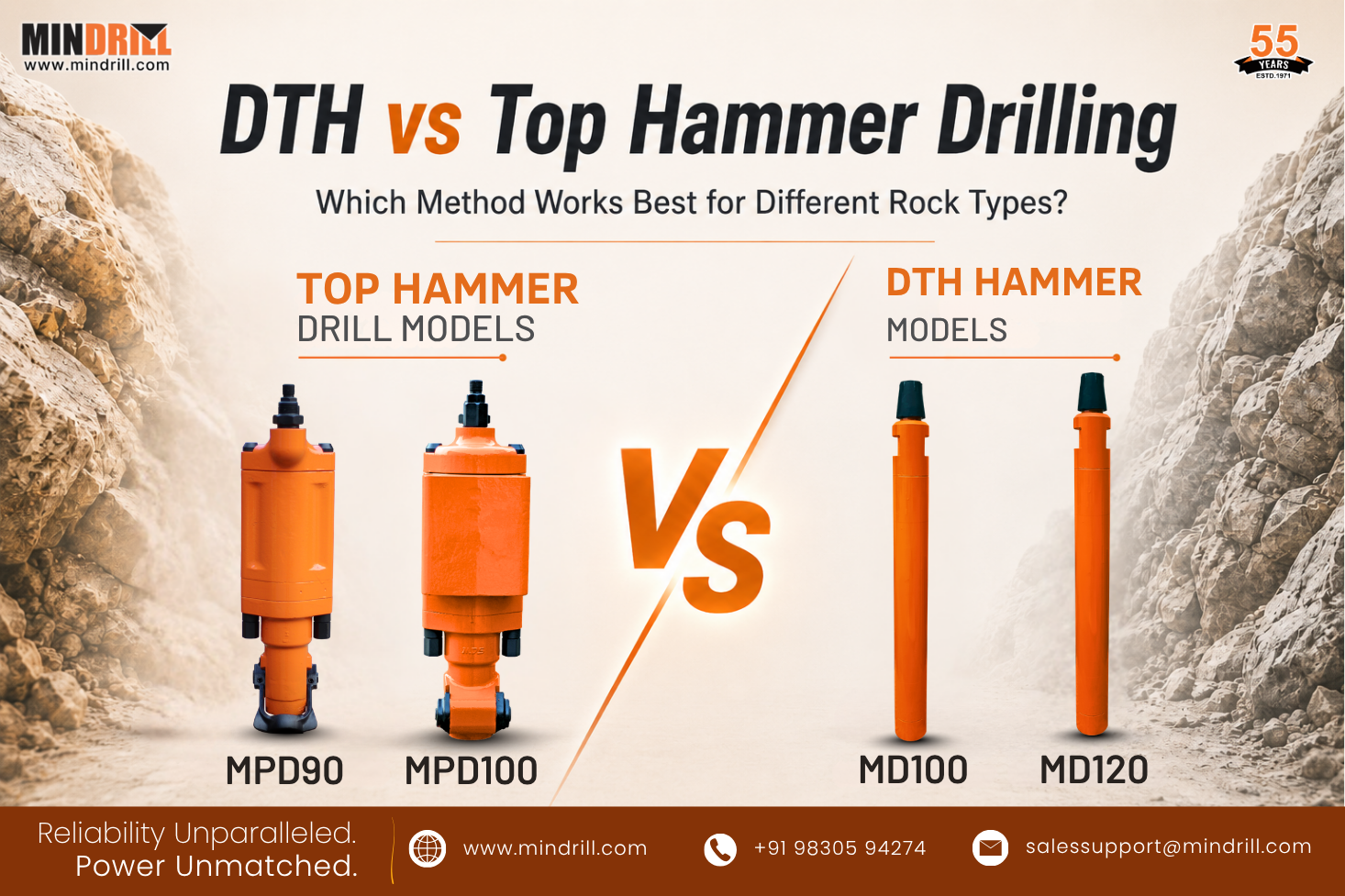
Not sure where to start? Below is a selection of our proven Top Hammer and DTH Hammer products — each built for demanding conditions and backed by Mindrill's commitment to quality and performance.
Top Hammer Drill Models
Our Top Hammer range covers a variety of applications — from lightweight handheld sinker drills to powerful hydraulic drifters suited for heavy-duty surface and underground work.
Handheld Rock Drills
| Model |
Type |
Best For |
CE Certified |
| MH505L |
Handheld Sinker Drill |
Surface rock drilling, construction blasting |
✔ Yes |
| MH100D |
Handheld Rock Drill |
Lightweight drilling in confined spaces |
✔ Yes |
| MH100T |
Handheld Rock Drill |
Stoping and overhead drilling |
✔ Yes |
Hydraulic Drifters — MPD Series
| Model |
Type |
Best For |
Drive |
CE Certified |
| MPD90 |
Hydraulic Drifter |
Underground tunneling, bench drilling |
Hydraulic |
✔ Yes |
| MPD100 |
Hydraulic Drifter |
Medium to hard rock formation drilling |
Hydraulic |
✔ Yes |
| MPD120 |
Hydraulic Drifter |
Heavy-duty surface and underground drilling |
Hydraulic |
✔ Yes |
DTH Hammer Models
Our DTH Hammer lineup is built for deep, high-performance drilling in the toughest rock conditions. Each model is engineered for reliable energy transfer and long service life.
| Model |
Length (w/o bit) |
Outside Dia. |
Weight |
Cylinder Bore |
CE Certified |
| MD100 DTH Hammer |
914 mm |
98 mm |
38 kg |
— |
✔ Yes |
| MD120 DTH Hammer |
980 mm |
107 mm |
47 kg |
88 mm |
✔ Yes |
Find the Right Drilling Equipment at Mindrill
Browse our full range of DTH Hammer and Top Hammer products at mindrill.com, or get in touch with our team directly. We're happy to talk through your project requirements and recommend the equipment that will give you the best performance for your specific drilling conditions.
Contact Us Today →
Tags: DTH Hammer, Top Hammer, MD100, MD120 DTH Hammer, MPD90, MPD100, MPD120, MH505L, MH100D, MH100T, rock drilling, underground mining