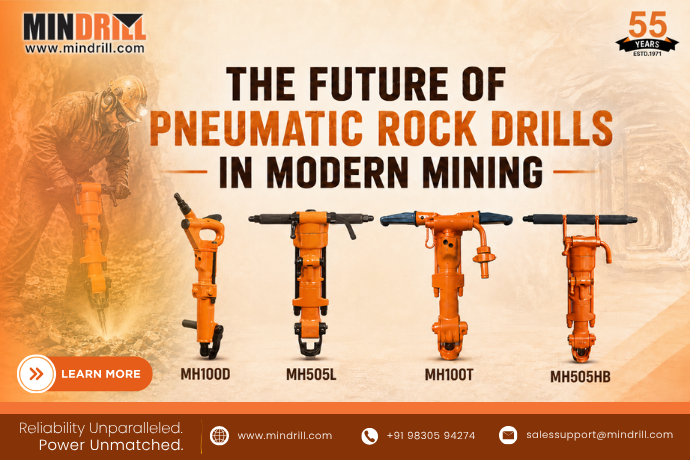
Mining has always been one of the most demanding industries on the planet. Every ton of ore extracted, every tunnel blasted, every foundation anchored depends on one critical piece of equipment — the rock drill. And while the industry has gone through sweeping changes over the past two decades, pneumatic rock drills haven’t just survived the shift. They’ve evolved into some of the most precise, dependable, and efficient tools in the modern miner’s arsenal.
So where exactly are pneumatic drills headed? And what does The Future of Pneumatic Rock Drills in Modern Mining look like for mining operations that still rely on compressed-air-powered equipment? The answer lies in understanding both the challenges facing the industry and the engineering breakthroughs that are meeting them head-on.
Why Pneumatic Still Dominates Underground
There’s a reason pneumatic rock drills have outlasted dozens of “next generation” alternatives. Underground environments are harsh — wet, confined, and filled with flammable gases in some cases. Electric and hydraulic systems have their place, but compressed air remains inherently safe in conditions where a spark or a hydraulic fluid leak could mean disaster. That safety advantage is irreplaceable, and it forms the foundation of why pneumatic drilling technology continues to be specified for tunneling, mining, and construction projects globally.
But safety alone doesn’t drive market preference. Performance does. Modern pneumatic drills have closed the gap dramatically on their hydraulic counterparts in terms of impact energy and penetration rates. What’s changed is the engineering behind the piston, the valve timing, and the overall build quality — factors that define how a drill performs over a 12-hour shift in punishing conditions.
Smarter Design, Longer Life
One of the most significant trends shaping the future of pneumatic rock drilling is the move toward smarter, longer-lasting designs. Operators today don’t just want a drill that works — they want one that works consistently, with minimal downtime and low total cost of ownership. That’s a challenge that manufacturers have taken seriously.
Take the
MH505L, for example. Designed for demanding medium-duty drilling applications, this model reflects the direction the industry is moving — compact enough for confined spaces, yet powerful enough to deliver consistent penetration in hard rock formations. The MH505L’s design prioritizes durability without adding unnecessary weight, making it a practical choice for operations where portability and power need to coexist.
Similarly, the
MH100D represents the growing demand for versatility on site. Mining projects today rarely involve a single rock type or a uniform set of conditions. The MH100D is built to handle variation — from moderately fractured ground to dense igneous formations — with a design that adapts without requiring constant tool changes or adjustments.
“The future of pneumatic drilling isn’t about replacing compressed air — it’s about getting more out of every cubic foot of it.”
Precision and Control in the Modern Drift
Modern mining operations are also pushing hard on precision. Blast hole accuracy directly affects fragmentation quality, which affects ore recovery, crusher throughput, and ultimately profitability. Drills that wander or vibrate excessively during operation aren’t just frustrating — they’re expensive. The industry’s next phase of pneumatic drill development is focused squarely on improving control and reducing operator fatigue.
The
MH100T is a strong example of this philosophy put into practice. Built for top-hammer drilling applications, it offers the kind of balance between impact frequency and rotational torque that allows operators to maintain straighter holes over depth — critical in production drilling where deviation costs money. As mines go deeper and tolerances get tighter, this level of control becomes less of a premium feature and more of a baseline expectation.
Heavy-Duty Demands, Heavy-Duty Solutions
Not every application calls for compact agility. Some of the most important drilling work in the world happens in conditions that would destroy lighter equipment outright — large-diameter blast holes, reinforced anchoring, primary development in hard rock mines operating at depth. For these applications, brute capability matters.
The
MH505HB is built with exactly these environments in mind. As a heavy-duty pneumatic rock drill, it delivers the kind of sustained power output that large-scale mining operations depend on, while maintaining the reliability profile that keeps scheduled maintenance on track and unplanned downtime minimal. In an industry where every hour of lost drilling time translates to real financial cost, that reliability isn’t just a feature — it’s a competitive advantage.
What the Future Actually Looks Like
The pneumatic rock drill of tomorrow will look different from the one in use today — but not in the ways people often assume. The air-powered core isn’t going anywhere. What’s changing is everything around it: materials science is delivering harder, lighter alloy components; simulation-driven design is optimizing piston geometry in ways that weren’t possible a decade ago; and real-world field data is feeding back into product development cycles faster than ever.
There’s also a growing conversation around operator wellbeing. Vibration-induced health issues have long been a concern in drilling operations, and the next generation of pneumatic drills is being designed with vibration dampening and ergonomic handling as first-order priorities, not afterthoughts. The miners who use this equipment every day deserve tools that protect them as well as they perform.
For mining companies evaluating their equipment strategies, the message is straightforward: pneumatic technology isn’t a legacy choice. When it’s specified correctly — with the right model for the application, from a manufacturer that invests in engineering quality — it’s a forward-looking one. The drills being built today will define productivity benchmarks for the decade ahead.
At Mindrill, that future is already being shaped — one precisely engineered drill at a time.
Get Free Quote today! Call us at +91 98305 94274 or email salessupport@mindrill.com.
Visit our website: www.mindrill.com to explore our range of trenchless solutions.