Dimensional Stone Quarry Drilling: Tools, Techniques, and Key Challenges
Dimensional stone quarries—producing granite, marble, sandstone, and limestone—depend heavily on precision drillingrather than blasting. The goal is simple: extract large, crack-free blocks with maximum recovery and minimum wastage. Unlike conventional mining, where fragmentation is desired, quarry drilling focuses on controlled separation of stone along defined lines. This makes the choice of tools, drilling methods, and operational discipline critical to quarry productivity.
Why Precision Drilling Matters in Stone Quarries
In dimensional stone extraction, even minor vibrations or inaccurate hole alignment can cause micro-cracks, reducing block quality and market value. Proper drilling ensures:
- Clean block separation
- Higher block recovery rate
- Reduced material loss
- Minimal environmental disturbance
- Better safety for operators
Techniques such as line drilling, plug and feather, and controlled horizontal and vertical drilling are commonly used to define the cutting plane before mechanical splitting or wire sawing.
Common Drilling Techniques Used
Line Drilling
A series of closely spaced holes are drilled in a straight line to create a plane of weakness. This method is widely used in granite and marble quarries for accurate block shaping.
Horizontal and Vertical Drilling
Vertical holes define block boundaries, while horizontal holes help in base separation. Accuracy in angle and depth is essential for clean extraction.
Plug and Feather Method
After drilling, wedges are inserted into the holes to gently split the rock along the drill line without shocks or vibrations.
All these methods demand consistent hole diameter, alignment, and depth, which can only be achieved with reliable rock drilling equipment.
Essential Tools for Dimensional Stone Quarry Drilling
Choosing the right equipment plays a vital role in achieving precision and productivity.
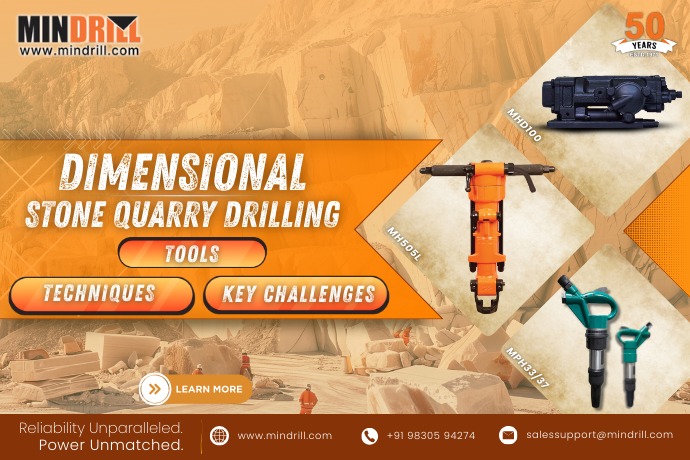
- MH505L Pneumatic Jack Hammer – Ideal for line drilling and vertical hole applications in granite and marble quarries. Its robust design ensures consistent performance with low vibration, making it suitable for precision work.
- MPH33 & MPH37 Pick Hammers – These are highly effective for secondary breaking, trimming, and controlled stone separation after primary drilling. They help quarry operators shape blocks without inducing cracks.
- MHD100 Hydraulic Drifter – Used where higher penetration and accuracy are required, especially in large quarries. It delivers powerful yet controlled drilling, ideal for defined hole patterns in hard rock formations.
These tools ensure that quarry operations maintain accuracy, efficiency, and block integrity.
Key Challenges Faced in Quarry Drilling
Despite advancements, quarry operators often face several challenges:
- Tool wear due to hard rock formations like granite
- Maintaining hole straightness over depth
- Avoiding vibrations that lead to fractures
- Managing compressor efficiency and air pressure
- Operator skill dependency for precision drilling
Addressing these challenges requires a combination of high-quality equipment, proper maintenance, and trained operators.
Improving Quarry Productivity with the Right Approach
By adopting the correct drilling pattern and using purpose-built tools, quarries can significantly improve output. Proper equipment reduces downtime, enhances drilling accuracy, and increases the overall life of drill rods and bits. Most importantly, it ensures maximum recovery of high-value stone blocks, directly impacting profitability.
Get the Right Drilling Solutions for Your Quarry
Mindrill Systems & Solutions Pvt. Ltd. offers reliable and efficient drilling equipment designed specifically for demanding quarry conditions.
Get Free Quote
📞 +91 98305 94274
📧 salessupport@mindrill.com
🌐 www.mindrill.com